MCP vs REST API for social media automation
Both can publish the same post to the same network. The difference is who decides what to send — your code, or a model reading a tool schema. That single distinction determines everything else.
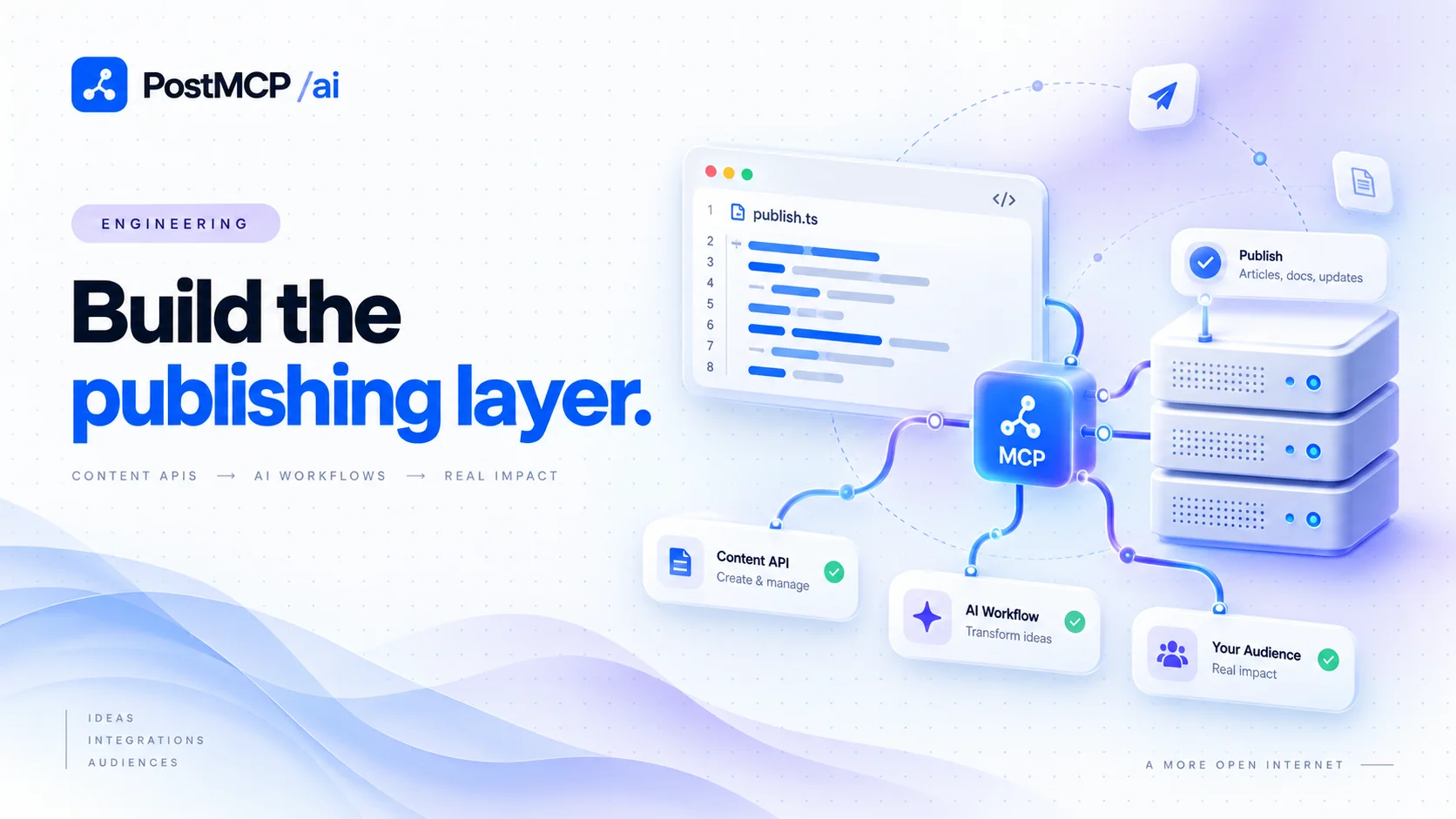
Both can put the same words on the same LinkedIn feed at the same time. Underneath, PostMCP’s MCP server calls the same backend the REST API exposes. So the question is not which is more capable. It is who decides what gets sent.
| REST API | MCP server | |
|---|---|---|
| Caller | Code you wrote | A model, mid-conversation |
| Payload | You construct it | The model constructs it from a schema |
| Discovery | You read the docs | The client reads the tool list at connect time |
| Determinism | Same input, same output | Same input, similar output |
| Latency | One HTTP round trip | Inference plus one or more tool calls |
| Cost per action | A request | Tokens for schemas, reasoning and results |
| Best at | Volume, repetition, guarantees | Judgement, ambiguity, ad-hoc work |
Where REST wins outright
Anything that should happen the same way every time.
If your app posts a formatted announcement each time a customer completes onboarding, that is a template with variables. Putting a language model in that path buys you nothing and costs you three things: nondeterminism in the copy, tokens per execution, and a new failure mode where the model decides to be creative on the one occasion you needed it not to be.
- High volume. Thousands of posts a month, where per-action token cost compounds.
- Strict formatting. Legal disclaimers, ticker symbols, release numbers — anything where paraphrase is a defect.
- Tight latency budgets. A webhook handler that must return in 200ms cannot wait on inference.
- Backfills and migrations. Loops over ten thousand rows want a client library, not a chat.
The REST surface is also where the guarantees live: idempotency, explicit status codes, retry semantics you control. Wire that directly and you can reason about it.
Where MCP wins outright
Anything where the instruction is ambiguous and a human is nearby.
“Announce the release, but keep the X version punchy and put the technical detail on LinkedIn” is not a payload. It is a judgement call about tone, length and audience, followed by four or five API calls. Expressing that as code means writing the judgement into the code. Expressing it as a sentence means the model makes the call and you review the output.
REST is for the work you can specify in advance. MCP is for the work you can only describe.
- Ad-hoc publishing. The post you decided to write ninety seconds ago.
- Context-rich work. In Cursor, the changelog is already on screen. The best announcement is written from it, in place.
- Multi-step recovery. “Three posts failed last night — find out why and retry the ones that are safe to retry” is a loop over
get_post, a read of per-profile errors, and a selectivepublish_post_now. Writing that as a script takes an afternoon. Asking for it takes a sentence. - Exploration. Anything where you do not yet know which endpoint you want.
The error-handling difference nobody mentions
With REST, an error is yours to handle. You get a status code and a body, and whatever your code does next is what happens next. That is a feature: the behaviour is written down.
With MCP, the error goes back to the model, which will try something. Sometimes that is exactly right — an over-limit X post comes back as a limit error, and the model shortens the copy and retries without being asked. Sometimes it is exactly wrong — a rate-limit error prompts an immediate retry, then another.
This is why a dry-run tool matters more in an MCP surface than a REST one. preflight_post lets the model discover the problem in a context where the only consequence is a rewrite, rather than in a context where the consequence is a half-published batch. If you are building your own server, that is the design lesson to steal.
Auth is genuinely different
With a REST API, your key is a server-side secret in your own environment. Familiar, well-understood.
With MCP over stdio, the key sits in a config file on a laptop — which is fine for one person and awkward for a team. With MCP over streamable HTTP, you are hosting a service that accepts a key by header or query parameter, and it needs the same care as any other public endpoint.
In all three cases the model never receives the credential; it sees tool names, arguments and results. But the operational question — who holds the key, and where — has three different answers, and it is worth deciding deliberately rather than by default.
The hybrid most teams land on
After a few months, the split usually settles like this:
| Workload | Surface |
|---|---|
| Product-triggered posts (signup, release, milestone) | REST — deterministic, high volume, no review |
| Weekly content batch | MCP — drafted with the agent, reviewed, scheduled in one multicall |
| Incident and failure recovery | MCP — inspect, reason, retry selectively |
| Analytics and reporting jobs | REST — cron, no judgement required |
| “Post this right now” | MCP — it is one sentence in a window you already have open |
Because both surfaces write to the same queue, the split has no cost. A post scheduled from Claude appears in the content calendar, can be edited there, and shows up in the same API listing your reporting job reads. The choice is per-workload, not per-company.
How to decide, in one question
Ask: could I write down, in advance, exactly what should be sent?
If yes, write it down — that is REST. If the answer starts with “well, it depends”, the dependency is judgement, and judgement is what a model in the loop is for. The API reference covers both surfaces, and the same key authenticates each.
Frequently asked questions
- What is the difference between an MCP server and a REST API?
- A REST API is called by code you wrote: you decide the endpoint, build the payload and handle the response. An MCP server is called by a language model that discovered the tools at runtime and chose which to invoke from a plain-English instruction. Both can hit the same backend; the difference is who makes the decision.
- Is MCP replacing REST APIs?
- No. MCP is usually a layer in front of a REST API rather than a replacement for it. Deterministic, high-volume, latency-sensitive paths belong in direct HTTP calls. Judgement-heavy, low-volume, human-in-the-loop paths are where a model choosing tools earns its keep.
- Which is cheaper to run?
- REST, by a wide margin, for anything repetitive. A direct HTTP call costs one request; the same action through a model costs tokens for the tool schemas, the reasoning and the results, and can involve several round trips. Below a few hundred posts a month the difference is noise; at scale it is not.
- Can I use both?
- That is the usual answer. Wire the deterministic product paths to the REST API, and expose the same account through an MCP server for ad-hoc work in Claude or Cursor. Both act on one queue, so a post scheduled from a chat window is visible and editable in the calendar.