Posting to X (Twitter) with an MCP server
X is the network where AI-written copy fails most visibly: everything is thirty characters too long and reads like a summary. What to do about it, mechanically.
X is where AI-written social copy fails most visibly, and for a mechanical reason: models are bad at counting characters. Ask for “under 280” and you will reliably get 310, delivered with confidence.
That makes X a useful lens on what a social media MCP server needs to do beyond “send the post”. Everything below is about the gap between a model writing copy and copy that a platform will accept.
How posting to X through MCP actually works
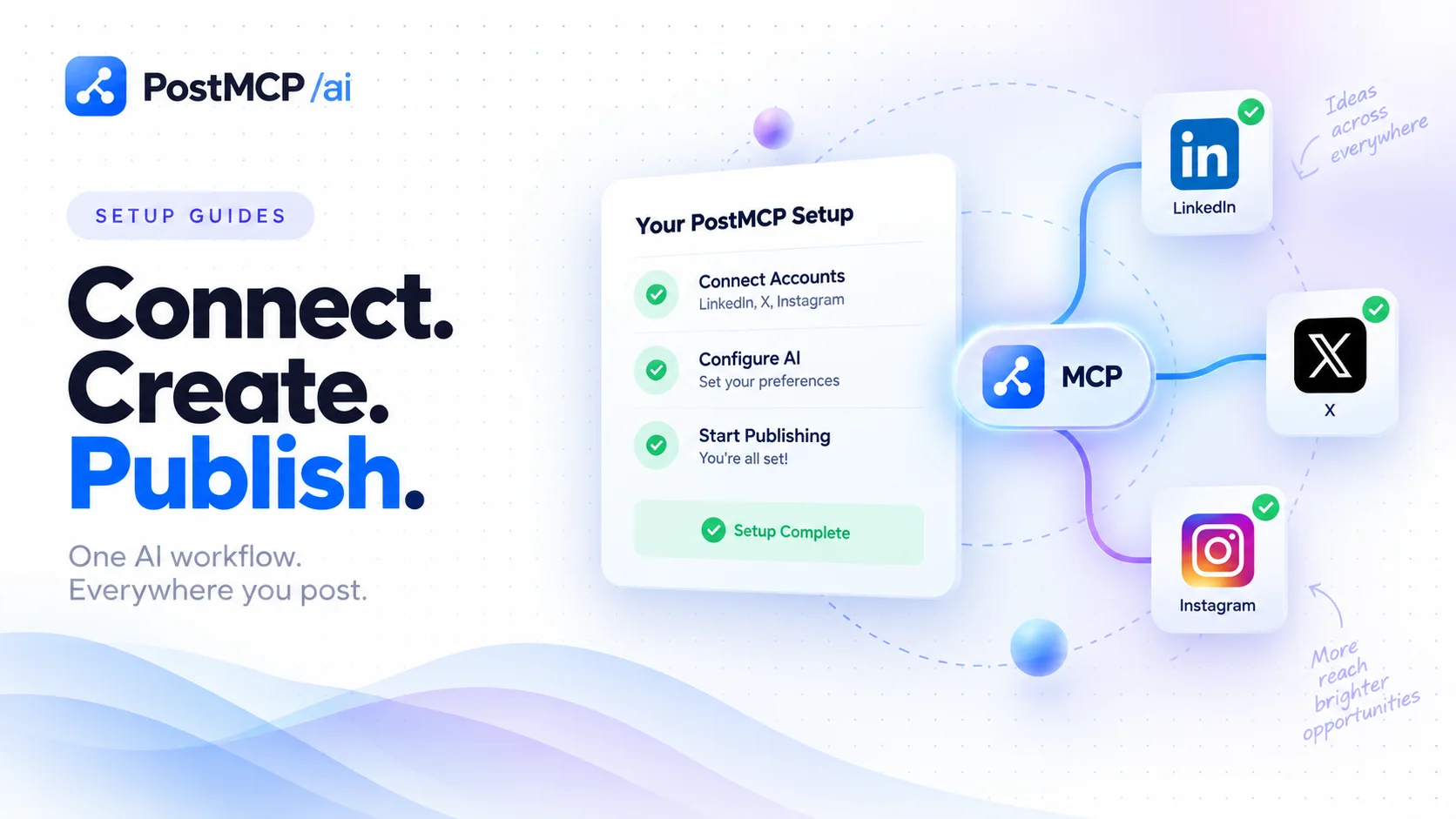
- 1Connect X once, through X
The account is authorised through X’s own OAuth sign-in on the publishing service. An encrypted access token comes back and stays in the backend vault. No password, app registration or API tier to manage yourself.
- 2Point your AI client at the MCP server
A five-line JSON block for Claude Desktop or Cursor; a hosted URL for Claude.ai. Publishing tools appear in the client’s tool list, and X is one of the profiles they can target.
- 3Ask for a post
The model drafts, calls
preflight_postto check the limit, fixes what is over, then callscreate_postagainst your XprofileId. You approve the write, and it comes back with the live URL.
Why preflight matters more on X than anywhere
LinkedIn gives you around 3,000 characters — nothing a model writes will hit it. X gives you 280, which every second draft exceeds.
Without a dry-run tool, the sequence is: model writes 310 characters, calls create, X rejects it, model apologises and rewrites. If the post was scheduled rather than immediate, that rejection happens at 9am on Tuesday with nobody watching.
preflight_post runs the same validation and publishes nothing. It reports the overflow per network, plus unconnected profiles, missing media and the credit cost. The model sees “34 characters over for twitter”, rewrites, and only then commits.
Do not cross-post the same paragraph
The clearest sign of an automated feed is a LinkedIn paragraph truncated into an X post. They are different rooms. LinkedIn rewards context and a first-person story; X punishes wind-up and rewards one claim you could quote.
The mechanism that fixes this is per-profile content: one instruction, different copy per destination, stored as separate posts.
{
  "content": "We shipped scheduled retries 🚀",
  "targetAccounts": [
    { "platform": "linkedin", "profileId": "lin_7741903",
      "content": "Failed posts used to need a human. From today they retry themselves — here is what we learned building it…" },
    { "platform": "twitter",  "profileId": "tw_1293847",
      "content": "Failed posts now retry themselves. No more Monday morning archaeology." }
  ],
  "scheduleDate": "2026-09-01",
  "scheduleTime": "10:00",
  "timezone": "Asia/Kolkata"
}
In practice you never write that JSON — you say “post this to both, but make the X version a single punchy line” and the model fills it in. The point is that the surface supports the distinction, so the model is not forced to choose one register for both. More on that in the cross-posting tool page.
One post per profile, and why it matters here
Targeting LinkedIn and X creates two independent records with their own ids and statuses. If X rejects yours for duplicate content while LinkedIn succeeds, you retry exactly one of them.
The alternative — one record with two destinations — makes retrying a gamble, because the safe action depends on partial state the agent has to reason about. Per-profile records remove the ambiguity, which is exactly what you want when the thing doing the retrying is a language model.
Prompts that work for X specifically
- Give a target, not a limit. “Aim for 200 characters” lands under 280 far more reliably than “stay under 280”, because it leaves room for the model’s bad estimate.
- Ask for one idea. “One claim, no list, no thread” prevents the summarising register that reads like a press release.
- Ban the tells. Rhetorical opening questions and “Here’s the thing:” are model defaults. Say so once and store it in your brand voice so you never say it again.
- Name the timezone. Scheduling defaults to UTC — “9am IST”, never just “9am”.
When a calendar beats a chat window
Drafting in conversation is excellent. Seeing a week of X posts laid out next to everything else is not something a chat window does well.
Both views read the same queue, so a post drafted in Claude appears in the X scheduler and can be edited or moved there. Use the agent for the writing and the calendar for the seeing — the split costs nothing, because it is one queue underneath.
Frequently asked questions
- Can I post to X (Twitter) using an MCP server?
- Yes. An MCP server that holds an authorised X connection exposes publishing as tools an assistant can call, so “post this to X” becomes a tool call rather than an HTTP request you write. The X account is connected once through OAuth; the assistant never sees the token.
- Do I need my own X API access to post through an MCP server?
- No. The publishing service holds the platform integration and you authorise your account to it through X’s own sign-in flow. You are not managing an app, tier or bearer token yourself.
- How do I stop AI-written posts from being too long for X?
- Use a preflight tool before creating anything. It reports character overflow per network without publishing, so the model finds out it is 34 characters over in a call with no consequences and rewrites. Telling the model the limit in the prompt helps but is not reliable on its own — models estimate length badly.
- Can one instruction post different copy to X and LinkedIn?
- Yes, and it should. Per-profile content lets the same instruction carry a 240-character version for X and a longer first-person version for LinkedIn, published as separate records so one failing does not affect the other.